


Which Midsize Truck Handles Off-Road Trails Best Around Loxley, AL? 2026 Toyota Tacoma vs 2026 Ford Ranger Raptor
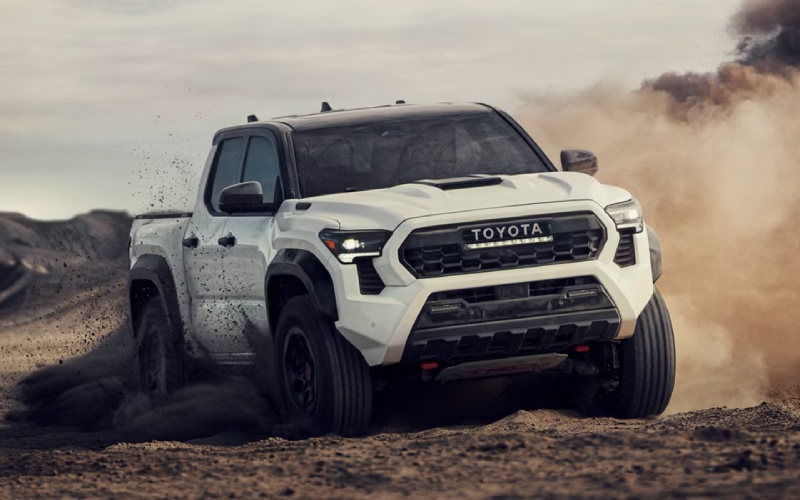
Eastern Shore Toyota – Which Midsize Truck Handles Off-Road Trails Best Around Loxley, AL? 2026 Toyota Tacoma vs 2026 Ford Ranger Raptor
When local drivers start mapping weekend trail runs or planning a backroads route to a hidden launch spot, the big question quickly becomes: which midsize pickup offers the better off-road toolkit without sacrificing daily drivability? Here we compare the latest trail-focused tech, chassis tuning, and real-world usability in a way that helps you decide what matters most for your mix of errands, commutes, and Gulf Coast exploring.
Both trucks bring genuine capability to the table, but the Tacoma lineup leans hard into off-road engineering details that pay dividends when the surface turns loose, rutted, or off-camber. The available 3D Multi-Terrain Monitor can show front, side, and area views below the truck to help you pick a clean line, while available Crawl Control (CRAWL) takes over throttle and braking at low speeds so you can concentrate on steering. Add the available Stabilizer Disconnect Mechanism (SDM) for increased wheel articulation, and Tacoma becomes far more settled over uneven ground. Ranger counters with off-road drive modes, available 360-Degree Camera, and specialized Raptor hardware, but its feature set doesn’t mirror the Tacoma’s combination of SDM, CRAWL, and ground-view camera tech across multiple trims.
Off-road control and confidence
A major difference in confidence off the pavement is how each truck manages traction and wheel travel. Tacoma’s multi-link rear suspension calms the rear axle over washboards and potholes, and on TRD Off-Road and TRD Pro you can step up to premium shock packages—Bilstein® monotubes with piggyback reservoirs or 2.5-in. FOX® Internal Bypass QS3® shocks—to improve heat dissipation and control when the going gets bumpy. Ranger’s FX4 hardware and Raptor’s suspension are noteworthy too, but Toyota’s Stabilizer Disconnect Mechanism stands out because it unlocks articulation that keeps tires connected to the terrain. The net result is a truck that stays composed while maintaining traction in both slow rock sections and faster fire roads.
Visibility plays a big role off-road, and that’s another place Tacoma’s available 3D Multi-Terrain Monitor helps. Seeing your wheel placement relative to rocks, roots, and dips can be the difference between a clean pass and a bent skid plate. Ranger’s 360-Degree Camera is a helpful tool for parking and spotting, but the Tacoma’s system is purpose-built for the trail and integrates cleanly with selectable drive modes and the low-speed CRAWL function.
Powertrains that fit daily life and the dirt
Torque matters as much as horsepower when you need to step over a ledge or pull a trailer up a wet ramp. Toyota’s available i-FORCE MAX hybrid pairs a turbocharged 2.4L with an electric motor for up to 326 horsepower and 465 lb.-ft. of torque, with response that feels immediate in stop-and-go traffic and on steep trail sections. If you prefer more involvement, Tacoma brings back an available 6-speed intelligent Manual Transmission (iMT) on select trims—a unique offering in the segment. Ranger’s EcoBoost® engines deliver strong performance, especially the available 2.7L V6 and Raptor’s 3.0L V6, but you won’t find a hybrid option or a manual gearbox on the Ford side. For daily drives, the Tacoma’s torque delivery helps reduce shifting and throttle input, while off-road it allows controlled, low-RPM progress over obstacles.
In-cabin tech and power for real-world use
Cabin tech is more than flash when it saves time and reduces hassle. Tacoma’s available 14-in. Audio Multimedia display, paired with an available 12.3-in. digital gauge cluster, makes it easy to manage maps, camera feeds, and off-road readouts. Wireless Apple CarPlay® integration and a clean menu structure keep your hands and eyes where they belong. In the bed, Tacoma’s available 2400W AC power supply can run tools, compressors, or camp gear longer and more flexibly than the Ranger’s available Pro Power Onboard at 400W. Both trucks offer an integrated trailer brake controller and smart towing aids, but Tacoma adds Trailer Backup Guide with Straight Path Assist to simplify reversing with a load—useful in tight trailhead parking lots or crowded marinas.
Safety and everyday confidence
Toyota Safety Sense™ 3.0 comes standard across the Tacoma lineup, bundling features like Pre-Collision with pedestrian detection, Lane Departure Alert with steering assist, and Dynamic Radar Cruise Control. These systems help reduce fatigue on longer drives and support awareness in busy traffic. Ford Co-Pilot360® brings comparable support to Ranger with useful tools like BLIS® with Cross-Traffic Alert and Trailer Coverage. The distinction is that Toyota integrates its suite broadly and layers in off-road visibility with the 3D Multi-Terrain Monitor, so whether your tires are on asphalt or gravel, you benefit from intuitive tech that just works.
- Trail traction and control: Tacoma’s SDM, CRAWL, and shock tuning give it a planted, predictable feel when the surface gets loose.
- Power and drivability: The available i-FORCE MAX hybrid delivers instant torque; the returning 6-speed manual adds rare engagement for enthusiasts.
- Utility and visibility: A 14-in. touchscreen, 12.3-in. cluster, 3D Multi-Terrain Monitor, and 2400W AC power supply enhance both workdays and weekends.
If your off-road checklist includes traction, articulation, and visibility, the Tacoma checks more boxes without asking you to compromise on daily civility. Steering feel is precise, throttle calibration is smooth, and the chassis stays settled even as the trail gets rougher. These are the kinds of details that matter after hours on the move, whether you’re linking fire roads or easing through a technical section with spotter calls over the radio.
Frequently Asked Questions:
Does the Tacoma’s hybrid change how it drives off-road?
Yes. The available i-FORCE MAX hybrid’s electric assist adds low-RPM torque that helps the truck crawl cleanly over obstacles and pick up speed smoothly on loose surfaces. That controlled torque delivery is also helpful when backing a trailer on a slick ramp.
Is the Tacoma’s 14-in. display useful on the trail, or just a big screen?
It’s genuinely useful. The larger display makes camera feeds and off-road menus easier to read at a glance, while the available 12.3-in. digital cluster keeps key info—drive modes, pitch/roll, and safety alerts—front and center.
How do the camera systems differ?
Both trucks offer a 360-degree view, but Tacoma’s available 3D Multi-Terrain Monitor is designed to show ground and wheel placement to support off-road decision-making. It’s especially helpful for spotting rocks, ruts, or drop-offs hiding just past the hood line.
Ultimately, both pickups are capable. The difference shows up in how Tacoma’s specialized off-road features are made available across the lineup and in how its hybrid torque, visibility tools, and chassis tuning simplify common trail challenges. That balance of finesse and toughness is what makes a long day outdoors more fun and less work.
For those weighing a test drive and a longer look at accessory options, Eastern Shore Toyota is here to help—serving Loxley, Fairhope, and Mobile with guidance grounded in local terrain and everyday driving needs. Bring your questions about trail hardware, towing tech, or multimedia setup, and we will help you configure the right build for your next adventure.
0 comment(s) so far on Which Midsize Truck Handles Off-Road Trails Best Around Loxley, AL? 2026 Toyota Tacoma vs 2026 Ford Ranger Raptor